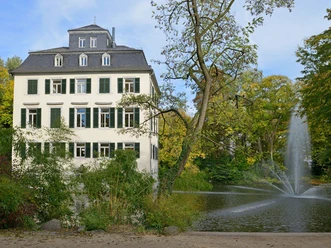
Over the course of its more than 200-year history, the park near the Alte Oper has undergone many changes: When Amschel Mayer von Rothschild purchased the property on Bockenheimer Landstraße in 1816, it was still on the outskirts of the city and was initially laid out as a kitchen garden complete with a garden house. But as early as the 1830s, he had the property converted into an English landscape park, complete with a neoclassical mansion and a neo-Gothic tower. A good hundred years later, in 1938, the Jewish Rothschild family was forced to sell the park. It was not returned to them until 1951.
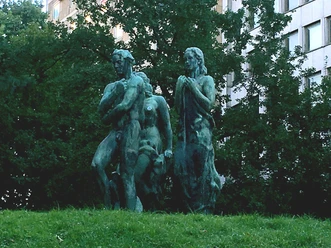
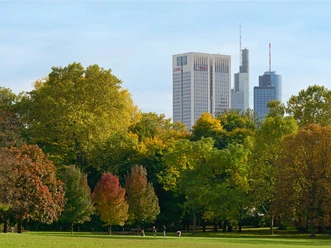
Today, the park—whose palace was destroyed during World War II—serves as a municipal green space, featuring expansive meadows, imposing old trees, winding paths, a restored Neo-Gothic tower, a children’s playground, and Georg Kolbe’s larger-than-life “Ring of Statues.” The artwork is a recurring topic of debate, as the sculptor’s role during the Nazi era is controversial.
Today, the park—whose palace was destroyed during World War II—serves as a municipal green space, featuring expansive meadows, imposing old trees, winding paths, a restored Neo-Gothic tower, a children’s playground, and Georg Kolbe’s larger-than-life “Ring of Statues.” The artwork is a recurring topic of debate, as the sculptor’s role during the Nazi era is controversial.
Payment methods
- Entrance Free
Author
Plazy #visitfrankfurt
Organization
Tourismus- und Congress GmbH Frankfurt am Main
License (master data)
Plazy #visitfrankfurt