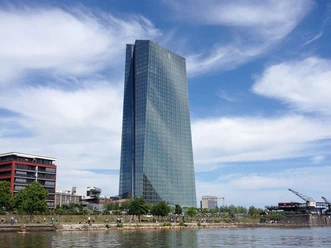
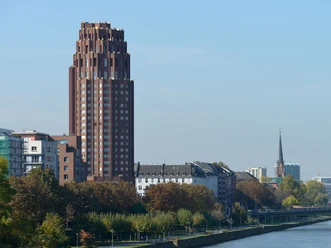
"Gemiesekirch", Hessian for "vegetable church" - that was the nickname of the wholesale market hall in Ostend. Where fruit and vegetable wholesaling for the entire Rhine-Main region took place until 2004, the European Central Bank (ECB) now sets the course for the financial world. And even if the glass ECB Tower attracts attention: The hall next door is an architectural icon of classical modernism. Its construction enjoyed absolute priority as a matter for the boss. It was designed by Frankfurt's city planning director Martin Elsässer (1884-1957), one of the coordinators of the New Frankfurt program, which helped the city to build 15,000 new apartments, industrial buildings, schools and churches. The most expensive single project was the Grossmarkthalle, which Elsässer designed as a complex. Two eight-storey head buildings frame the 200-metre-long and 50-metre-wide hall - at the time of its inauguration in 1928, there was no larger column-free reinforced concrete building in the world.
Today, the hall houses the lobby of the ECB, as well as exhibition rooms, a visitor center, a cafeteria and conference rooms. A dark chapter of the past has not been left out either: a memorial with touching quotes from contemporary witnesses recalls the period between 1941 and 1945, when Jewish citizens were locked up in the cellars of the Grossmarkthalle and deported from here to the extermination camps.
Today, the hall houses the lobby of the ECB, as well as exhibition rooms, a visitor center, a cafeteria and conference rooms. A dark chapter of the past has not been left out either: a memorial with touching quotes from contemporary witnesses recalls the period between 1941 and 1945, when Jewish citizens were locked up in the cellars of the Grossmarkthalle and deported from here to the extermination camps.
Author
Plazy #visitfrankfurt
Organization
Tourismus- und Congress GmbH Frankfurt am Main
License (master data)
Plazy #visitfrankfurt